Dossier On-farm composting
Compost is the best source of stable organic matter, improves soil structure, increases crop disease resistance, and ensures more stable crop yields. But as a farmer, how do you start farm composting? What processes do you need to follow, and how can you tell when compost is ready? And how can farmers work together and find support at a regional level?
What does ILVO do?
-
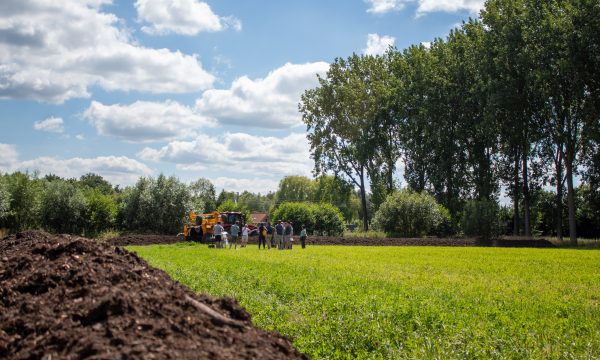
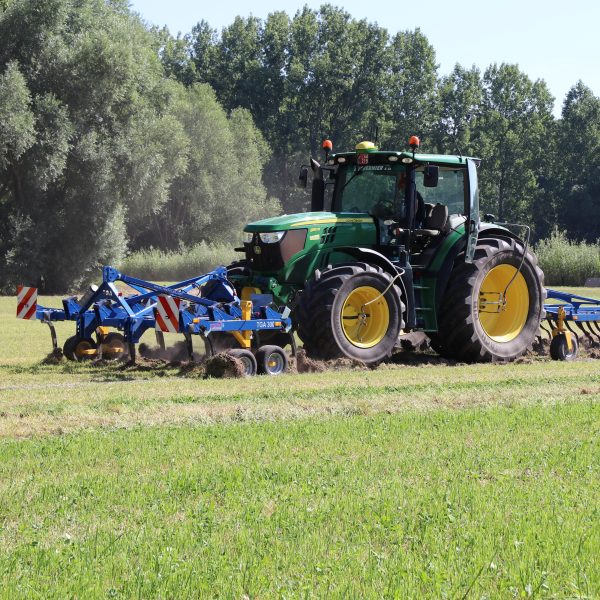
 At their compost site, ILVO optimizes recipes and processes; test fields facilitate long-term research into compost use.


Inhoudstabel
- Why compost?
- Making compost
- Compost is ready in 2 to 3 months
- Compost application
- Regional collaboration
1. Why compost?
Composting is the conversion of organic waste products such as plant residues, feed residues, and manure into an earth-like product that can be used as a soil improver. It offers many benefits for soil quality and crop yields. In addition, composting maximizes the preservation and recycling of organic matter, plant nutrients, and other useful components from waste products in the cycle on the farm, but also at the landscape level.
Composting plant residues and manure also limits the risk of nutrient losses through volatilization and leaching, not only before but also during and after application, and reduces the risk of transferring pathogens.
Compost is therefore not only a high-quality product but also a safe product with many benefits for farmers, soil, crops, and society at large.
On-farm composing
There are different categories of compost. Organic compost, prepared from vegetable, fruit, and garden waste, and green compost, prepared from green waste, are offered for sale by industrial composting companies for use on agricultural land.
Farm compost is prepared on-farm using the farm's own organic waste products, such as crop residues and manure, possibly supplemented with residues from forest, nature, and landscape management, and applied to agricultural land.
Processing management residues into farm compost can create a win-win situation: farmers get more woody biomass, especially coarser grass clippings, which nature organizations want to get rid of in order to create less nutrient-rich conditions.
For more than 20 years, there has been a demand for a facilitating legal framework for farm composting in Flanders. Het Mestdecreet (The Fertilization Decree, Article 3, §5, 3°) provides a definition of farm composting, stating that farmers may collaborate with up to two other farmers to exchange organic waste streams and manure, and use the finished compost within the partnership. Wood material and grass clippings from nature management may also be used for composting.
Currently, as a farmer, if you receive external organic residual streams, you are subject to a permit requirement and must comply with the same VLAREM standards as industrial composting companies. You must provide liquid-tight paving to prepare compost and collect leachate.
ILVO is working as a partner to develop a legal framework that facilitates on-farm composting.
> Clarity expected in regulations for on-farm composting (in Dutch) - VILT
ILVO is a pioneer in Flanders in the field of farm composting research and has over 20 years of experience in quantifying the effects of compost on soil quality and crop yield. At its own composting site, in addition to producing compost for its own use, research is conducted into the optimization of the initial mixture, the process flow, and the storage conditions. ILVO also conducts research into the soil-improving potential of various organic products through pot trials and long-term multi-year field trials.
> Press release about ILVO's compost site (in Dutch)
Effect on crop yield and soil quality
Compost is rich in nutrients, soil organisms, and stable organic matter, the key element for soil fertility and the preservation and utilization of nutrients. Soils need a continuous supply of organic material, and compost is a suitable product for this purpose.
More stable crop yields
An important added value of repeatedly using compost on agricultural soils is that it results in more stable crop yields in times of more extreme weather conditions. This is because compost:
- increases or maintains soil organic matter
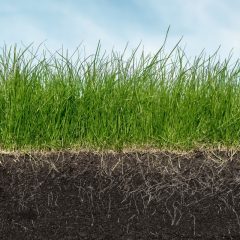
The creation of humus (stable organic matter) improves soil structure, reducing the risk of silting, compaction, and erosion, and promoting crop rooting, nutrient retention, and soil water management. In soil rich in organic (carbon) matter, water can infiltrate better during wet periods, resulting in less runoff, a lower risk of flooding, and better replenishment of groundwater and surface water. In dry periods, this soil can provide more moisture to crops and retain water from sudden, heavy rainfall by acting as a sponge.
- increasing or buffering pH
A pH that is too low or too high can hinder the availability and uptake of nutrients. Compost has an acid-binding value because it contains free lime (CaCO3). A sufficiently high organic matter content buffers against pH fluctuations and counteracts soil acidification.
- expanding the soil food web
A more active and diverse soil life (bacteria, fungi, nematodes, etc.) contributes to a better soil structure by forming soil structure elements and supports the root activity of crops. It also promotes soil fertility and increases disease resistance, enabling farmers to save on crop protection products.
- applying plant nutrients with a reduced risk of losses
By using compost, you apply all the necessary nutrients for the crops. The risk of nutrient loss is lower—during and after application—compared to other forms of fertilization because mineral nutrients bind to the organic matter fraction or the clay minerals in the compost and because some of the nutrients are bound in the stable organic matter.
> Compost delivers complete fertilization – Wageningen UR (in Dutch)
Limit phosphorus
The phosphorus reserve is (too) high in many Flemish agricultural soils. ILVO has demonstrated that the phosphorus reserve can increase through the annual application of compost if the phosphorus input, via compost and other forms of fertilization, is higher than the phosphorus export via the crops.
Depending on the starting mixture, compost can have a lower nitrogen:phosphate (N:P2O5) ratio than farmyard manure.
Research has shown that the nitrogen:phosphate ratio of compost, in which manure was combined with plant material, is lower than the nitrogen:phosphate ratio of manure. This lower nitrogen:phosphate ratio of compost means that when applying the same amount of phosphorus, compost adds less nitrogen than manure. In some cases, this leads to a lower yield.
Preparing compost with plant material that has a low phosphorus content results in phosphorus-poor compost.
2. Making compost
Compost is formed during a decomposition and transformation process through microbial activity in aerobic (oxygen-rich) conditions. All organic residues, both plant residues and animal manure, can serve as raw materials, but it is important to follow a few rules of thumb.
Compost composition
Organic residual streams are divided into two types: brown and green materials. A correct ratio between both types of materials is important for a good start and progress of the composting process and is expressed on a volume basis, which is practical for the composter.
Needed: brown and green materials, oxygen (O2) and moisture
- Brown materials are woodier, drier, less biodegradable, lower in nutrients, and richer in structure compared to green materials. They have a high carbon content and consequently a high carbon:nitrogen ratio (C:N). Their coarser structure ensures the supply of oxygen in the pile.
Examples are shredded wood, twigs, straw, hay stalks, and tree leaves.
- Green materials typically have a high moisture content, decompose more quickly, and are rich in nutrients. They are rich in nitrogen, which results in a low C:N ratio.
Examples include leafy plant material such as grass clippings and leafy hay, but manure is also considered green material due to its high nitrogen content and high moisture content. The C:N ratio of manure depends on the amount of straw added (the more straw, the higher the C:N), but remains well below the C:N of brown materials.
60% brown, 40% green
The optimal composition of the initial mixture is determined on a volume basis, mixing 60% brown material with 40% green material, which ensures an optimal initial C:N ratio of 25 to 35:1.
A sufficiently high C:N ratio is crucial to limit nitrogen losses. The brown material also provides the structure needed for air exchange through a natural chimney effect. Composting is an aerobic process and requires a continuous supply of oxygen (O2) and removal of carbon dioxide (CO2).
More than 60% brown material (C:N > 35:1) will moderate the temperature rise, which can prevent the killing of weed seeds and prolong the composting time. If the source material is free of weed seeds, this compost can also be of excellent quality with a high organic matter content.
60-70% moisture
At the start of the process, the moisture content must be sufficiently high, namely 60 to 70% by weight. This is important for the preservation and utilization of the exempt nitrogen, among others.
During the process, moisture and nutrients are released when green material decomposes. The drier brown material absorbs this process moisture and prevents nutrients from leaching out of the pile. The high temperatures also cause a lot of moisture loss through evaporation.
To prevent the composting process from stopping due to moisture deficiency, you must add water in good time. This is best done while turning the pile.
Constructing a compost pile
The green and brown materials can be laid in layers in a pile on solid ground or a concrete slab. The lightest materials are placed at the bottom to ensure good mixing during the first pass with the compost turner. Using many different source materials and reducing the size of the woody biomass will contribute to a favorable process and the quality of the end product.
The best shape for a compost heap is a ridge: an elongated heap 2 to 4 meters wide and 1 to 2 meters high. This limited cross-section guarantees the necessary oxygen supply for the respiration of the organisms that break down and transform the organic material. A lack of oxygen leads to rotting and thus leaching or volatilization.
Heat development creates a chimney effect, whereby moist warm air escapes from the top of the heap and drier cold air enters via the sides. The limited cross-section of the pile guarantees this air circulation, which maintains the oxygen content and removes excess carbon dioxide (CO2). If the natural chimney effect is insufficient, the pile is turned with a compost turner.
To ensure that the process runs smoothly and can be controlled, it is important that the pile has a uniform composition throughout its entire length. Fresh organic material can be added, but this must be limited in time.
> See this video: Boerderijcompostering
Monitoring: temperature, CO2 and moisture
To control the composting process, you often need to measure the temperature and available oxygen at the start.
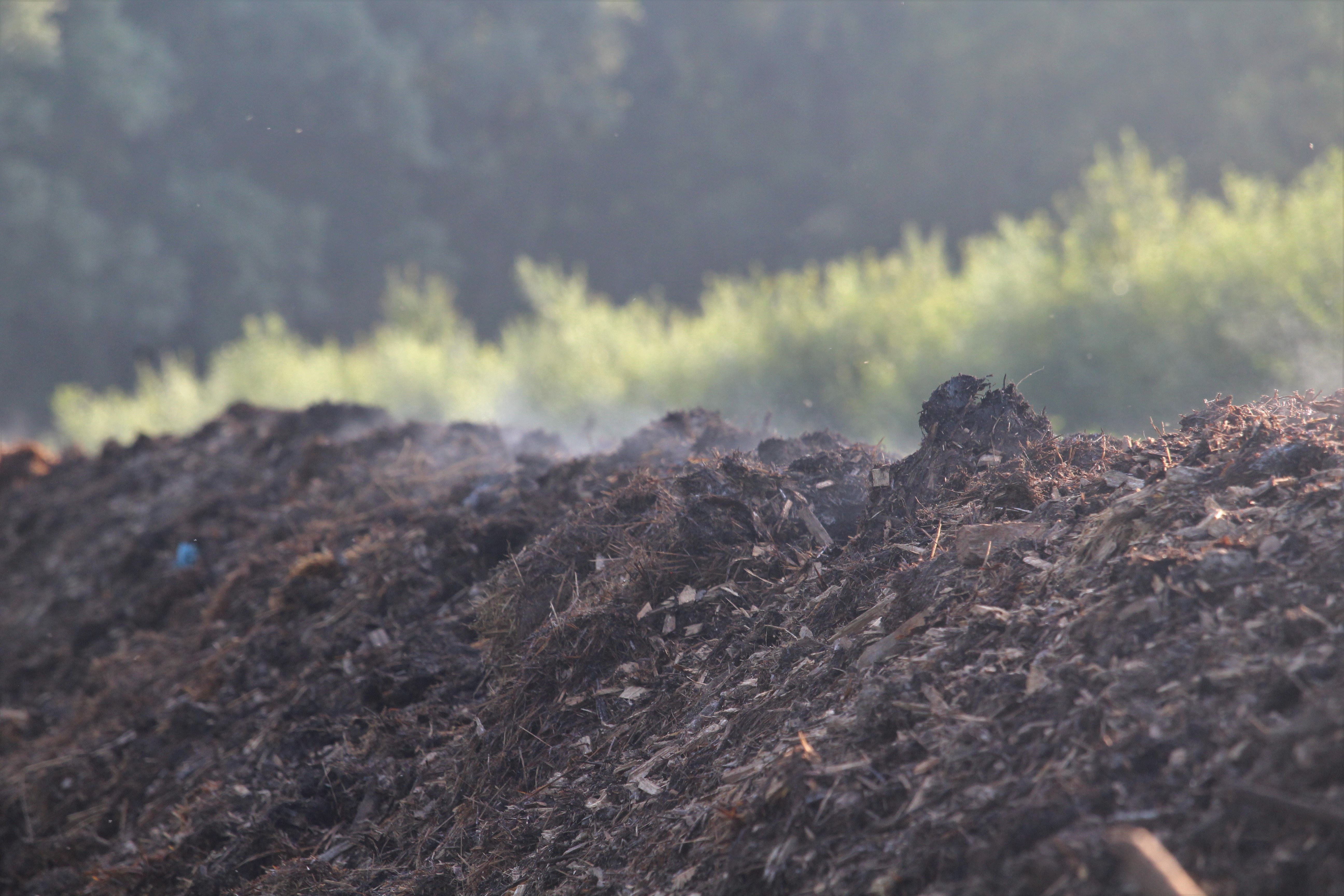
If you have mixed green and brown materials in the right proportions and the moisture content is high enough, the process will start quickly. The temperature in the pile will then rise to 60 to 70°C, killing weed seeds and harmful organisms. Excessively high temperatures should be avoided due to excessive carbon loss.
The temperature is measured at the core of the pile using a thermometer with a probe.
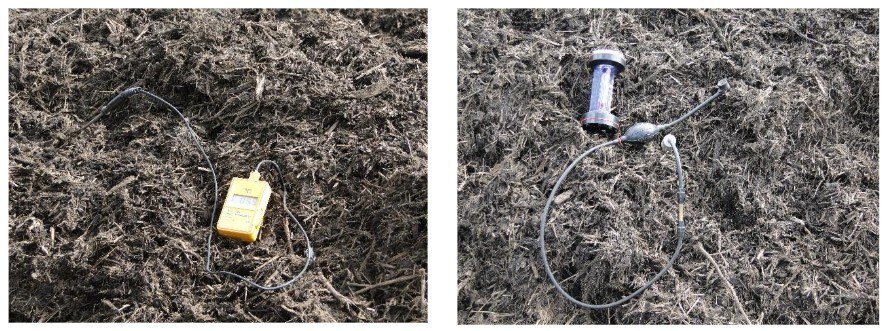
You don't measure the oxygen content directly, but determine it based on the CO2 content. Composting is a respiratory process in which, in addition to heat and water vapor, CO2 is produced when oxygen is consumed. An excessively high CO2 content therefore indicates an impending oxygen shortage.
The CO2 content is measured with a CO2 meter at the bottom of the pile, because CO2 gas is heavier than air.
In the initial phase of composting, you estimate the moisture content by squeezing a handful of compost: if water leaks out, the mixture is too wet; if it falls apart, it is too dry.
> See video Compost op ILVO
Turning compost
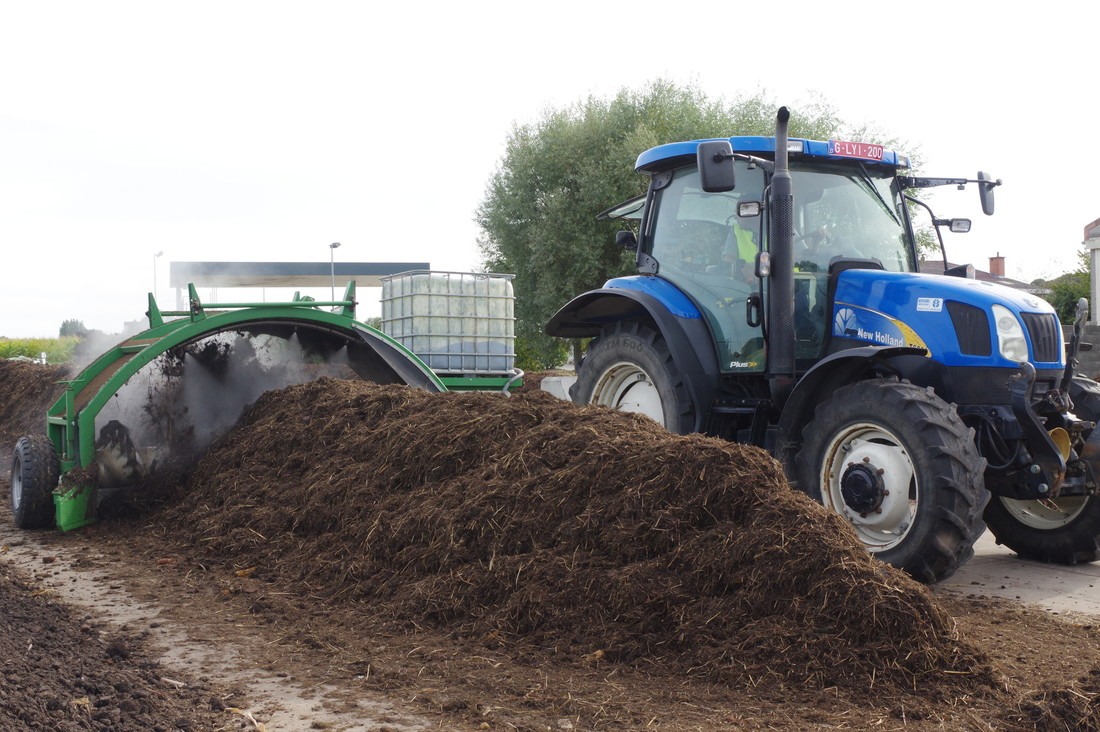
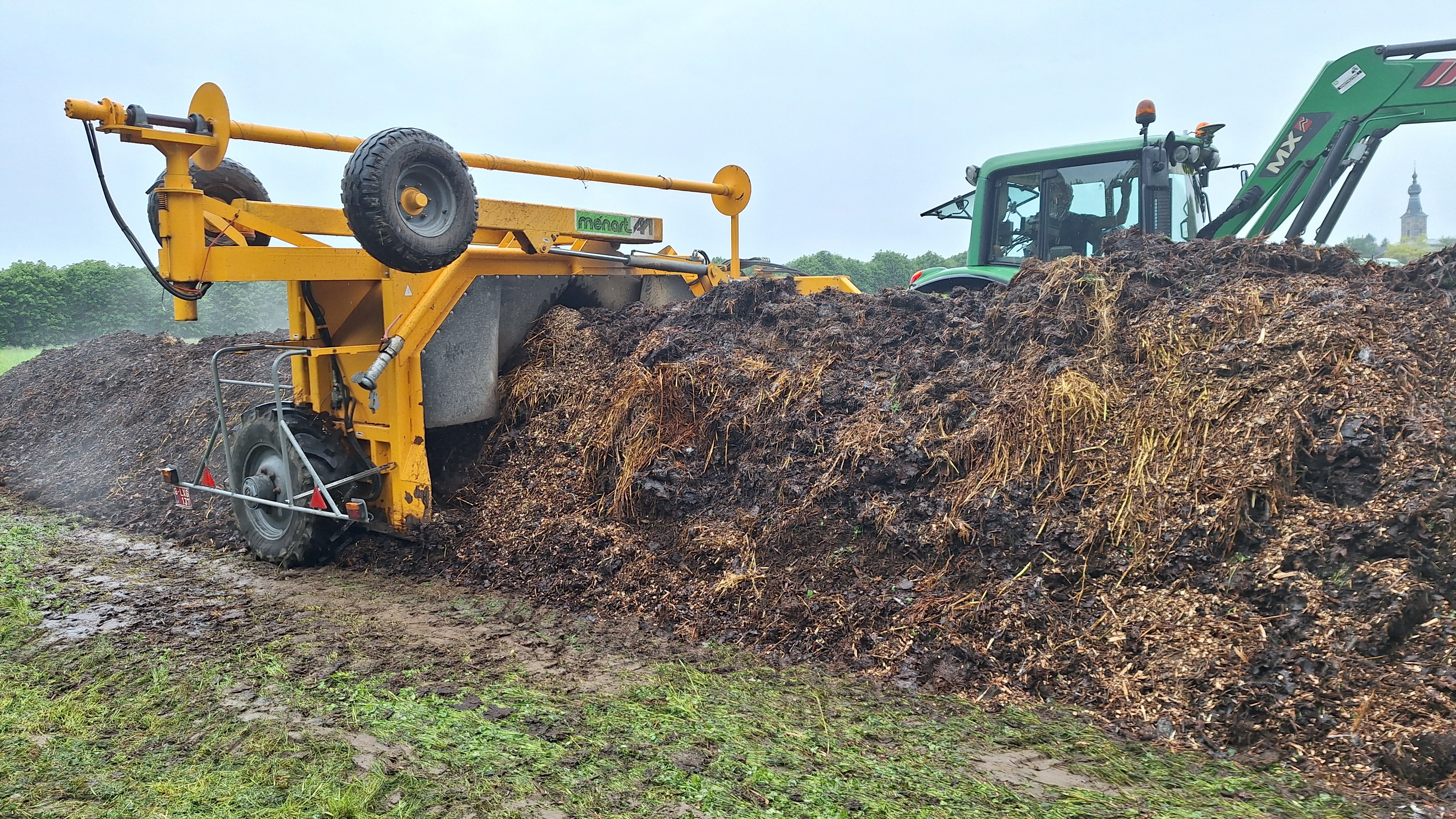
To keep the process going by controlling it and composting the entire mixture properly, you need to turn the compost heap several times. This is best done with a compost turner. The specific shape of the rotor not only ensures homogeneous mixing at the start, but also moves the material from the center of the heap to the sides and vice versa.
In the initial phase, you need to turn the heap more often. This is due to the high temperature development and oxygen consumption associated with intense biological activity. The ratio of green to brown materials is also a determining factor, and if there is a lot of green material, it will need to be turned several times during the first week. This decomposition phase is followed by a maturation phase, which requires less frequent turning.
In these situations, you need to turn the heap:
- Temperature > 65°
- CO2 level > 16 vol%
- When compost is too dry, add water
3. Compost ready after 2 to 3 months
On average, a pile of farmyard compost is ready ('mature') after two to three months. The duration depends on the composition of the initial mixture and the management of the process.
The composting time is longer with a higher proportion and less reduction of woody material. A temporary moisture shortage also slows down the process.
The first indication that the composting process is coming to an end is a sharp drop in temperature. You can also easily recognize mature compost by:
- smell
Good compost doesn't smell bad. The smell varies from neutral to woodsy.
A rotten egg smell indicates high sulfur levels due to rotting (too wet); an ammonia smell indicates unstable and therefore immature compost that contains too much nitrogen due to an excess of green material.
- color
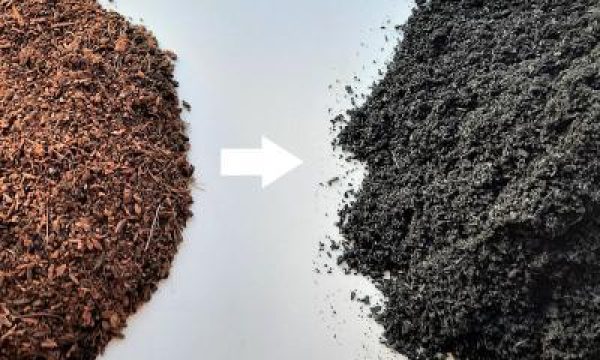
The color varies from light to dark brown; the higher the moisture content, the darker the color. Ash-gray or jet-black compost is caused by excessively high temperatures.
- structure
Mature compost is crumbly. Its structure can vary depending on the composting time.
Coarser compost is usually younger and improves soil structure by activating soil biology. This compost can require soil nitrogen for further digestion and has a slower effect.
Finer compost is usually better digested and nourishes plants immediately.
- moisture
To maintain the quality of the compost during storage, the moisture content should not be too high; approximately 50% is optimal.
These four characteristics are easy to check. But there are other indicators you can use to determine whether you have good, mature compost.
> Read ‘Wat is goede compost? (in Dutch) for more information about these indicators and how to determine them.
> Download Compost Scorekaarten (in Dutch)
4. Compost application
You don't need to work compost into the soil to limit nitrogen volatilization. Most of the nitrogen in compost is organically bound. Compost contains only a very small amount of mineral nitrogen in the form of ammonium nitrogen, the form of nitrogen that is subject to volatilization. In mature compost, less ammonium nitrogen is formed and it is quickly converted to nitrate nitrogen.
When applying compost as a soil improver, the timing does not matter. If you want to replenish nutrient deficiencies, it is best to apply it as soon as possible, before the next main crop.
Mature compost can be spread in the spring because you can sow and plant in it without any problems. Young compost is best applied in the fall, just before sowing a green manure.
It is preferable to apply compost regularly in moderate amounts rather than in one large dose, especially in light soils.
> Praktische infofiche boerderijcompostering – B3W
5. Regional collaboration
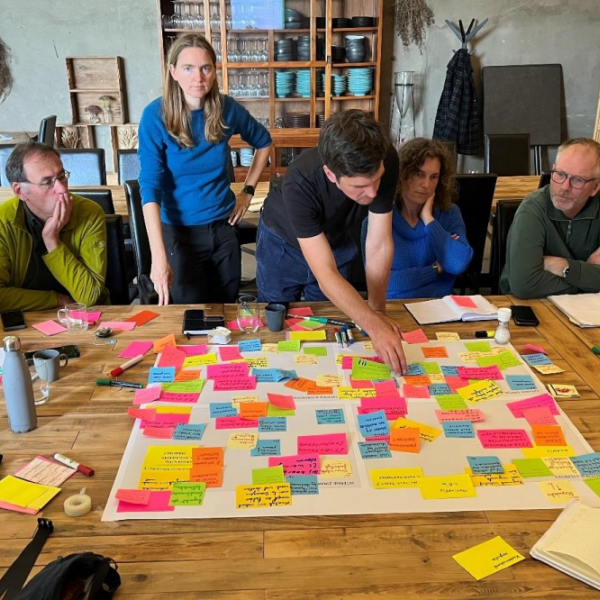
Farm composting has many agricultural advantages but places high demands on individual farmers. Not only does it involve preparing and storing the compost, but also negotiating with nature conservationists, monitoring quality, and applying the compost itself, all of which add up to a full workload. Despite the interest of both conventional and organic farmers, this is one of the main reasons why it is relatively uncommon in practice (in addition to the lack of a clear legislative framework).
In order to be truly successful and make farm composting feasible and workable, regional cooperation is needed—between farmers themselves and between agriculture and nature. This will relieve the burden on individual farms and also make compost preparation and application more economically attractive. A collective approach also lightens the to-do list, such as discussions with nature managers about the appropriate delivery of residual materials.
First composting project demonstrates potential
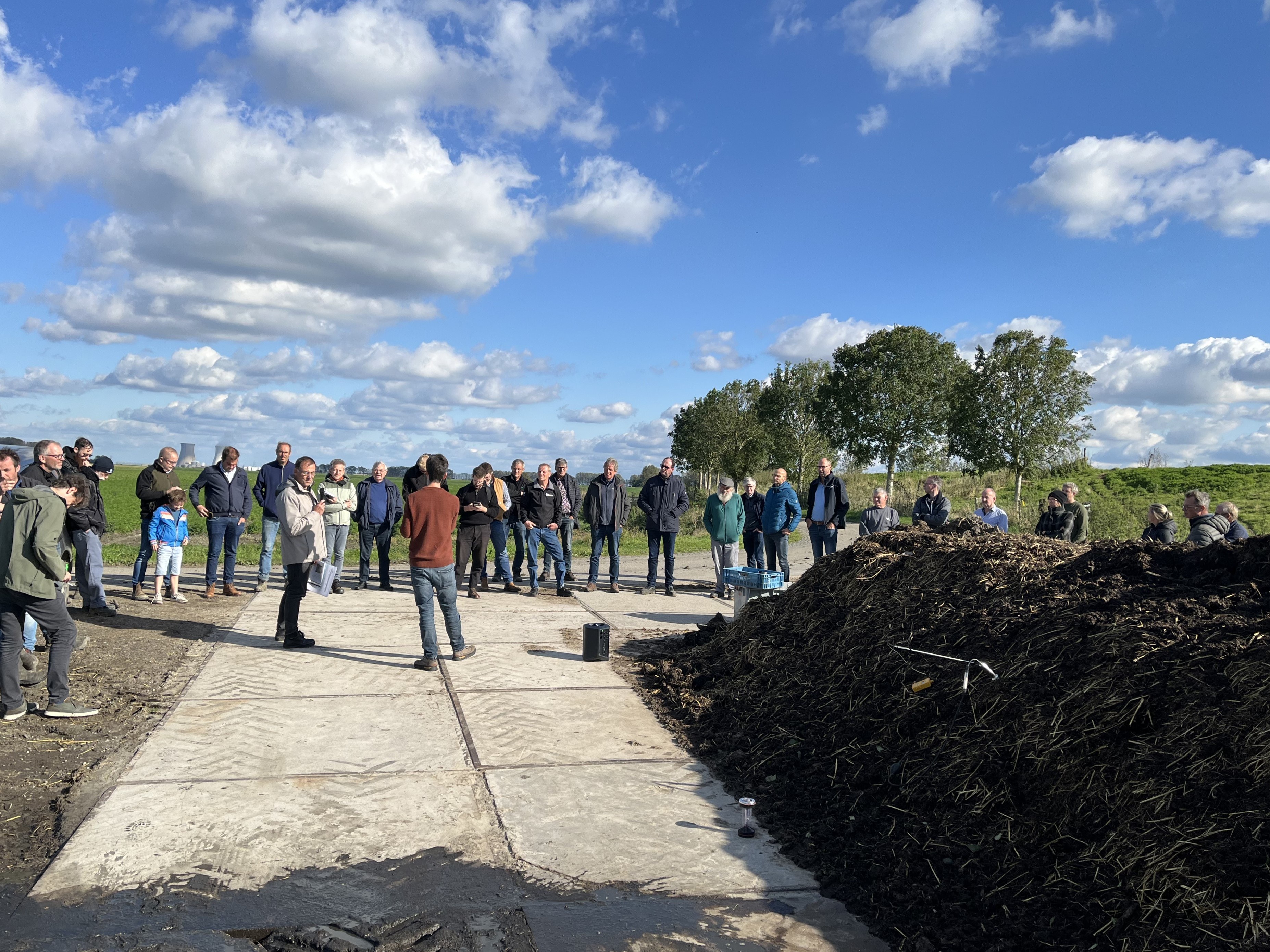
Research into the feasibility of a regional composting concept in the Groot Saeftinghe Border Park by ILVO clearly shows potential and confirms the desire of various stakeholders to work together on farm composting.
Crucial to successful scaling up and regional cooperation is:
- Strategic use of public biomass flows. This biomass is owned by public institutions (in jargon: with a public institution as the "holder") and is decisive. Not only are the flows massive, because public institutions control many biomass sources (road verges, dikes, nature reserves), they are also stable in terms of availability. They change little because public biomass mainly comes from the management of things that cannot be moved or is linked to local or regional general interests. The management of dikes, nature reserves, reed beds, etc. will always be necessary.
- Creating cooperative alliances to solve logistical issues such as: where is which biomass available, how can it be harvested and stored, how and when can it be transported to individual farms, what temporary storage is needed, and at what level is this best organized.
- Deciding on the machinery needed. The need for machinery and tools (compost turners, measuring equipment, etc.) is a challenge, but it resolves itself as the scale increases. Contractors (both inside and outside the border park) indicate that the contracting market will organize itself accordingly as soon as there is sufficient demand from farmers for these types of services.
- Getting the right guidance during the pilot phase. Composting requires an understanding of the quality of residual streams, the process, and the desired quality of the end product. Guidance is not only necessary for building up this professional knowledge, but also provides insight into the logistical aspects of farm composting and how to integrate compost application into fertilization practices or, more broadly, into general soil management.
Once a few legislative hurdles at the Flemish level have been addressed, a blueprint will be ready for further upscaling to other areas. The lessons learned from the research in the Groot Saeftinghe Border Park are highly relevant to other regional partnerships such as Landscape Parks and National Parks, the Water+Land+Schap program, and the regional activities of the provinces and the Environment Department. Developments in the border park are therefore being followed with interest in various other regions in Flanders and the Netherlands.
> View the webinar (in Dutch) Composteringsproject Grenspark Groot Saeftinghe of read the final report (in Dutch) Uitwerking van een regionaal composteringsproject in het Grenspark Groot Saeftinghe - ILVO.