News | Project news | Publication Inspiration for water and agriculture field workers: lessons learned about collaboration on blue-green measures for climate adaptation.
Blue-green measures on a landscape scale require a customized approach, a flexible area-specific approach, and ongoing dialogue between various stakeholders, including farmers. This requires strong communication skills, trust, knowledge of tools, and the ability to respond flexibly to unexpected changes.
Area workers play a crucial role in this regard as bridge figures between science, field experience, and local actors. An area worker is an employee of a government agency, NGO, or other organization involved in rural development. He or she is active at the local or regional level in guiding, facilitating, and stimulating cooperation between various stakeholders, such as farmers, within a specific geographical area.
The rollout of blue-green measures is a continuous learning process at various levels. Learning takes place partly through doing and collaborating, but can also be reinforced by targeted learning environments within area-specific processes. At the start of the project, the Flemish government launched the Water-Land-Schap (WLS) policy program. This offered a unique opportunity to monitor collaboration on blue-green measures at the landscape scale in several locations simultaneously.This report brings together insights from workshops and interviews and consolidates existing knowledge about barriers and opportunities in the rollout of blue-green measures at the landscape scale. In this way, it aims to provide a source of inspiration and a decision-support framework for area workers involved in blue-green measures in the landscape.
Discover all the insights and practical tools in the Dutch-language inspiratiegids.
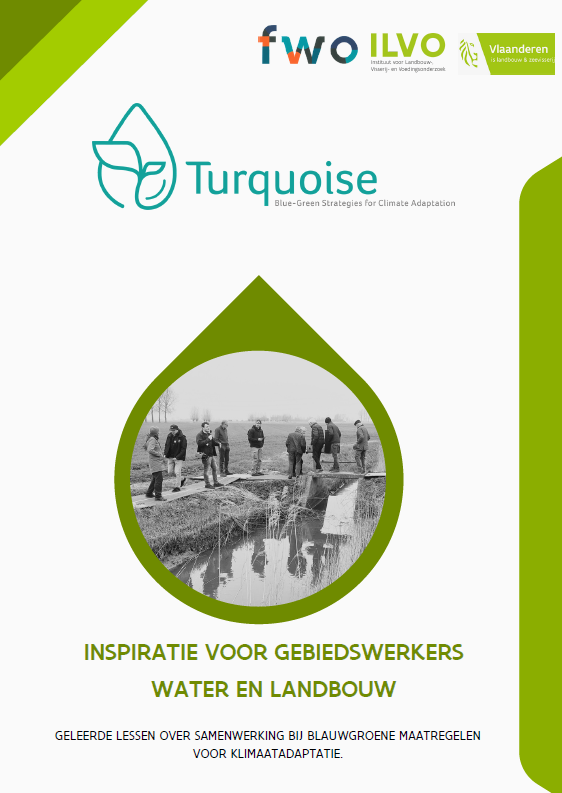
This inspiration guide is part of the multidisciplinary research project Turquoise – blue-green strategies for climate adaptation. The project is funded by the FWO and carried out in collaboration with the Catholic University of Leuven, the University of Antwerp, and Flanders Institute for Agricultural, Fisheries, and Food Research (ILVO). Turquoise focuses on a proactive, ecosystem-oriented strategy for water scarcity and drought in Flanders.