Research project Innovative control of pests and diseases in open air culture of ornamentals


General introduction
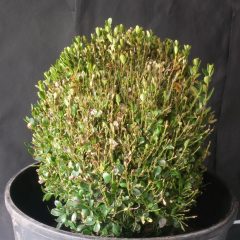
Within the project IZIPOS, non-chemical alternatives were tested for disease and pest management (IPM) in outdoor ornamental horticulture. Specifically, the researchers compared biocontrol products against Calonectria in Buxus and against Phytophthora in rhododendron with classical fungicides. At the conclusion of the project, there was no convincingly positive evaluation of the alternatives: none of the products tested performed adequately under strong disease pressure, not even the (at the outset) most promising (candidate) products.
For now, it appears particularly challenging to suppress diseases in outdoor crops with non-chemical products. The application of biocontrol organisms is also still limited, precisely because weather conditions cannot be controlled. On the other hand, the availability and social acceptance of chemical control measures for diseases and pests is under social pressure and we have to keep looking for alternative means.
Research approach
The project consisted of two parts. One focused on pests, namely the control of aphids on rhododendrons and caterpillars on boxwood, and the other on diseases, namely the control of Calonectria in boxwood and Phytophthora in rhododendrons. ILVO was only involved in the second part. Promising new bacterial preparations were tested for the control of Calonectria. However, these proved effective only at high relative humidity; otherwise, their survival on the leaf surface was too limited to be effective. Although several other biocontrol products showed some activity in some of the assays, only conventional fungicides were sufficiently active against Calonectria. Against Phytophthora, strong emphasis was placed on the potential of endophytic Serendipita species. After developing specific qPCR assays for the two most important species, we were able to demonstrate that Serendipita colonized the rhododendron roots and remained there for a long time. Unfortunately, this did not provide protection against Phytophthora. A reduction in symptoms was observed when a biocontrol product based on Trichoderma was applied preventatively during repotting. Only conventional fungicides, and then only when applied to the root zone, proved sufficiently active against Phytophthora. Trichoderma is compatible with the use of these fungicides, which therefore allows for a combination.
Relevance/Valorization
In both case studies, biocontrol products were identified that had limited activity against the pathogenic fungi. There appears to be considerable interest in the project from growers. The limited effectiveness of even promising (candidate) products against the diseases tested shows that there are no products that perform adequately under strong disease pressure. While some activity was observed, it must be increased before these products can be successfully and profitably used in practice. The results were valorized through direct communication to the industry and its suppliers.
Financing
VLAIO