Research project Breeding of forage grasses and grassland herbs


General introduction
In breeding grassland species, the ILVO breeding team strives for versatile varieties of grasses, clover and herbs. These, when blended into the grassland seed mix, not only ensure high-quality forage. They must also fit into a climate- and environmentally-friendly operation. These varieties of forage grass (ryegrass, Italian ryegrass, timothy, meadow fescue), clover (white and red) and herbs (plantain) show, as a result of their breeding process, the following characteristics: they give year-round high yields, their forage value (digestibility, protein content) is good, they are disease resistant and persistent, they make efficient use of available nutrients and available water, and they provide good seed yields. High-performance, complementary mixtures are established with the varieties of the various species.
Research approach
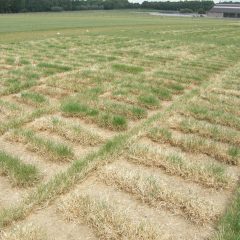
Within the natural variation in our breeding pool, individual plants with targeted traits are recombined through crosses. Using clone and family breeding schemes, progeny plants with the desired traits are combined to form new populations which are tested in trials in our own experimental fields. Beside yield potential, these trials also evaluate feeding quality using NIRS, and drought resistance by imposing drought using rainout shelters. Biotests are used to improve disease resistances. We are implementing the use of drone images in our breeding programs to predict traits like yield potential, clover content and drought resistance.
Relevance/Valorization
Around 40 % of the European farmland is grassland, making grass by far the most important forage resource for dairy and beef cattle farms. Multi-species grassland, composed of grass, clover and forbs, is more resilient, more biodiverse and requires less inputs compared to grass monocultures. Varieties with a high feeding quality warrant an efficient dairy and beef production with less nitrogen and methane emissions. The introduction of these new varieties and mixtures benefit not only the agricultural sector (both conventional and organic) but also society, the environment, biodiversity and the climate.